Uniform Guidelines
The goal of the 416th is to portray the common infantry soldier of the Red Army during the Great Patriotic War (World War Two) 1941-1945. These guidelines outline the items you would need for a good Krasnoarmyets (Red Armyman) impression. There are period items whose Soviet use can be documented but are not allowed under these guidelines. That is because those items are less common or inappropriate for a regular Soviet Rifle Unit. The Rifle (Infantry) units were by far the largest part of the Soviet military machine.
Important to keep in mind is that the 416th was NOT a Guards Rifle Regiment, making it lower on the supply chain when it came to new and replacement equipment.
Items are listed as PREFERRED, ACCEPTABLE, INCORRECT, REQUIRED or OPTIONAL.
PREFERRED is the category that you should be aiming for and acquire first. It represents items that are correct for the 416th.
ACCEPTABLE is the category of items that are period correct, but less appropriate for a rifle unit. You should always buy preferred and use acceptable only to fill holes.
INCORRECT is everything else not listed in the above two categories. We have only listed absolute NO-NO's. Not everything that is wrong is listed. If your item in question is not listed as preferred or acceptable please ask. It's important to ask, instead of showing up at an event and being told you cannot use it. Also use common sense such as no modern items, no incorrect materials, etc. We'd rather have you buy it right the first time instead of having to buy it again.
REQUIRED are those basic minimum impression items you need to have to take the field with the unit. Some of these items are required for safety reasons.
OPTIONAL listings are items that you may wish to have to enhance your impression. While nice to have they are not required.
These guidelines are based on RESEARCH and as research is constantly continuing the guidelines may be changed. Of course we will notify you of any changes, and welcome any suggestions for change. Just remember that any requests for change must be backed up by well-documented sources.
The bibliography contains many books that were used as research for these guidelines; however two books were a cut above the others. Those being:

Webster, David; Nelson, Chris: Uniforms of the Soviet Union 1918-1945 (1998)
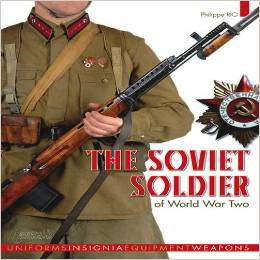
Rio, Philippe: The Soviet Soldier of World War Two (2012)
Both of these books are a wealth of pictures. Wartime photos and color item photos. Two good books that should be a priority for your uniform reference library.
Always remember to "STRIVE FOR AUTHENTICITY" and you will have an outstanding impression.
The guidelines are broken down into the sections listed below.
WEAPONS (Small Arms, Bayonets, Fighting Knives and Squad/Platoon Level Weapons)
UNIFORMS (Tunics, Trousers, Underwear, Headgear and Footwear)
EQUIPMENT (Weapon and Military Accoutrements)
WINTER WEAR (Winter Uniforms and Equipment)
MISC IMPRESSION ITEMS (The little stuff to boost your impression)
BIBLIOGRAPHY (Sources for information on WWII Red Army Uniforms and Equipment)
Some Historical and Unit Notes regarding these guidelines
Specialty Impressions
This covers all impressions outside of the standard Red Army Infantry impression, such as Sniper, Sapper, Engineer, Aviator, Naval, etc. These will not be allowed without the prior approval of the Commander and Authenticity Officer.
At some events the 416th will portray divisional recon elements. This is usually decided at the event. Partisan impressions will be allowed, however these regulations do not govern those impressions. Speak with unit leadership for guidance on Partisan impressions.
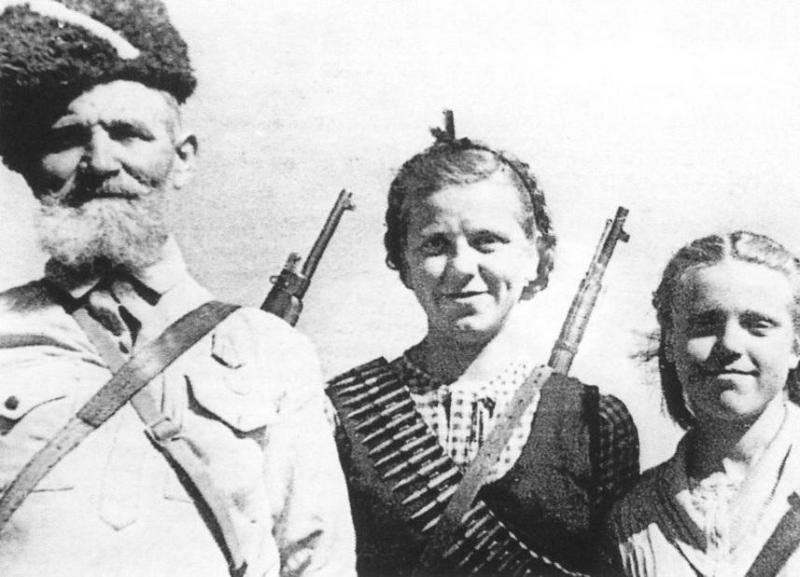
Russian partisans ranged widely in age as they waged a war behind the German lines disrupting supply and communications. The Germans were forced to commit troops to pacify rear areas that were needed at the front.
Captured Equipment
While captured equipment was used by the Red Army, we must restrict its use. Some reenactors tend to look like soldiers in a Russian uniform and kitted out German. Refrain from wearing/using too many German items. If your impression is overly German you will be asked to “lose” some of it. If spectators want to see German equipment, send them to the German camp. Let's endeavor to show them Russian equipment.
Lend Lease Equipment
A lot of lend lease equipment was sent to the Soviet Union by her British and United States allies. Everything from tanks, planes and locomotives to M43 uniforms and low boots manufactured in the United States. A few of these items found their way to the Frontovik. Some of the more common items were Studebaker 2 1/2 ton trucks, jeeps, boots and spam. The 416th should feel free to use these in their impression. Some lend lease infantry weapons were sent, but they would not have been common in a standard rifle division. Things like Thompson Sub-Machine Guns and Browning Machine Guns were sent, however their numbers would not have made them commonplace in an army of millions of men. With Guards units being higher in the supply pecking order they would have been issued to them first over a rifle division. We wish to portray the standard infantry soldier, so Russian weapons are the only ones authorized.
Camouflage Uniforms
The Russians did have some nice camo like amoeba, leaf and tri-print. However these were worn by Snipers, Airborne, Engineers and Scouts. Not the regular infantry soldier. We want to portray the common rifle soldier who was not issued this kind of clothing. The only camo authorized is over whites for winter tacticals. Winter camo was issued to units involved in offensive operations first. When it’s decided to portray recon at an event, camo is acceptable. Please be aware that there is a lot of fantasy camo available that has no documentation as wartime issue. Ask if you have questions, especially since there is such a thing as early war and late war camo.

A pair of Russian Scouts on the radio. Both are wearing the Amoeba pattern of camo suits.
Officers and NCO's Equipment
Those holding the rank of an NCO or Officer know the additional equipment that was carried by those soldiers, so those items are not detailed in these guidelines. Any questions on those impressions should be directed to them.
Medals, Orders and Awards
Please see the Unit Regulations on Medals, Orders and Awards. This details them and what criteria you would have to meet to be able to wear them. Soviets did wear their decorations and awards on their field uniforms, so if you have earned the award please feel free to wear the award.
Parade Uniforms
Parade uniforms are not covered in these guidelines. We represent a unit in the field. However if you wish to have a parade uniform to wear for dress functions, dances or what not, contact the Unit Authenticity Officer and they can help you.
Original Items
Because the war is fairly recent in a historical perspective many original items are available for the reenactor to use. Original items are great; however, caution should be used as reenacting tends to be very hard on them and can destroy an item or its value. Wearing original uniforms is discouraged as in the field they are easily torn or soiled. Original weapons and field gear stand up better, but keep in mind they can be subject to the elements. Rain and snow can rust your rifle before you have a chance to clean it.
Vendors
Please note we have removed the status of preferred vendors from these uniform regulations. Reason being is that several very good ones have come and gone from the hobby. Listed are several vendors specializing in original and reproduction soviet gear. If you can’t find something try eBay or ask other members where to get the item from.
Hair
Hair must be cut in a period fashion. Hair is always over the ear and off the collar. It is very common to see soldiers with short cropped hair. No modern military cuts. Look at photos and cut your hair to match. Absolutely no pony tails for men.
Facial Hair
Face must be shaven. You may have a neatly trimmed mustache. There are many different styles, please look at original photos. No beards unless you are old enough to have fought in the Russian Civil War (1917-1922). There are many photos of older soldiers with short beards, however younger soldiers do not. No goatees what so ever. A few days growth is ok if we are portraying soldiers in the field.
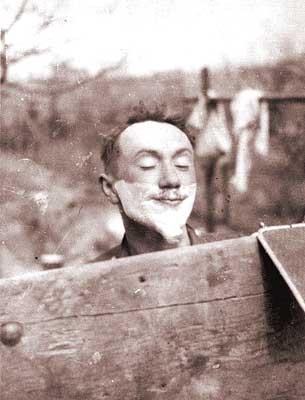
Shaving in the field.
Our rules vs. Event rules
There are times when an event rule will be stricter than our rule. Thus we have to defer to the event rule. More times than not this involves facial hair and everyone having to be clean shaven. If you have any confusion about event rules vs. unit rules, ask. Folks have been forced to cut their hair/shave in camp or told to leave.
Also, our rules will generally be stricter than other Soviet groups. Please refrain from telling people that their uniform, equipment or hair is farby or incorrect. This is considered rude and disrespectful. From many years of reenacting, we have found that it does no good to rip apart someone else’s impression. All it does is make you look like a jerk. If a reenactor wants to improve their impression they will ask you.
AUTHORS NOTE TO ALL
These uniform guidelines were written by Andy Swanson, Jon Boorom, Glenn Williams and Dave Pasbrig for the 416th Rifle Regiment. Many sources were consulted for them, ranging from books to collectors, their collections and everything in between. We are happy to share these with anyone interested in red army reenacting or the red army in the Great Patriotic War 1941-1945. Anyone may use these guidelines as long as proper credit is given to the authors and the unit.
WEAPONS
Small Arms
Mosin Nagant M91/30 (Required)
This 5 shot bolt action rifle is the standard weapon for the 416th. It is correct for any time frame of the war and any theater. It should be the first Soviet firearm you get for your impression. Make sure to get a canvas & leather dog collar sling and a cleaning rod for it.
Other infantry weapons allowed:
Mosin Nagant M38 Carbine (Cavalry, Vehicle and Weapon Crews Only)
Mosin Nagant M44 Carbine (Late War Only)
Mosin Nagant M91 Rifle
PPSh-41 Sub-Machinegun
PPS-43 Sub-Machinegun (Late War Only)
SVT-40 Semi-Automatic Rifle
Incorrect
- Captured Axis Weapons (We will allow limited use of a captured MP-40)
- US or British Weapons (M-1 Garands were NOT sent lend lease)
- Pistols or Revolvers (Only officers and special exceptions may carry a proper Russian handgun with the approval of the Unit Commander and Authenticity Officer)
Bayonet (Optional)
You may get a bayonet appropriate for your weapon if you so desire. Not all weapons had bayonets, like the sub-machine guns and the M38 carbine. Also not all soldiers bothered keeping track of their bayonets and sometimes discarded them thus making it an optional item.
The M44 Carbine has a folding bayonet attached to it.
If you decide to get a bayonet for your impression it can be carried reversed on the muzzle of the gun. For safety reasons you must tie the bayonet to the gun. Or get one of the canvas/leather bayonet scabbards. These scabbards were rare and only early war, however for safety reasons they will be permitted. NO LOOSE BAYONETS IN THE FIELD. Loose bayonets can be kept in the vehicle or camp for safety.

Early war photo of soldiers sharing cigarettes and waiting to board a train. Note the bayonets on the M91/30’s are reversed on the cleaning rod and through the upper dog collar of the sling, but not very secure to the rifle. For a reenactment you are required to secure your bayonet a little better. Also to note is the M-35 tunics devoid of insignia.
Fighting Knives (Optional)
This item was not carried by all soldiers.
Squad Weapons
The following list of squad/platoon level weapons are acceptable and will be dealt with as they come into the unit.
Maxim Model 1910 Machine Gun
Degtaryev DP-28 Light Machine Gun
1938 DShK 12.7mm Heavy Machine Gun
PTRD Anti-Tank Rifle
PTRS Anti-Tank Rifle
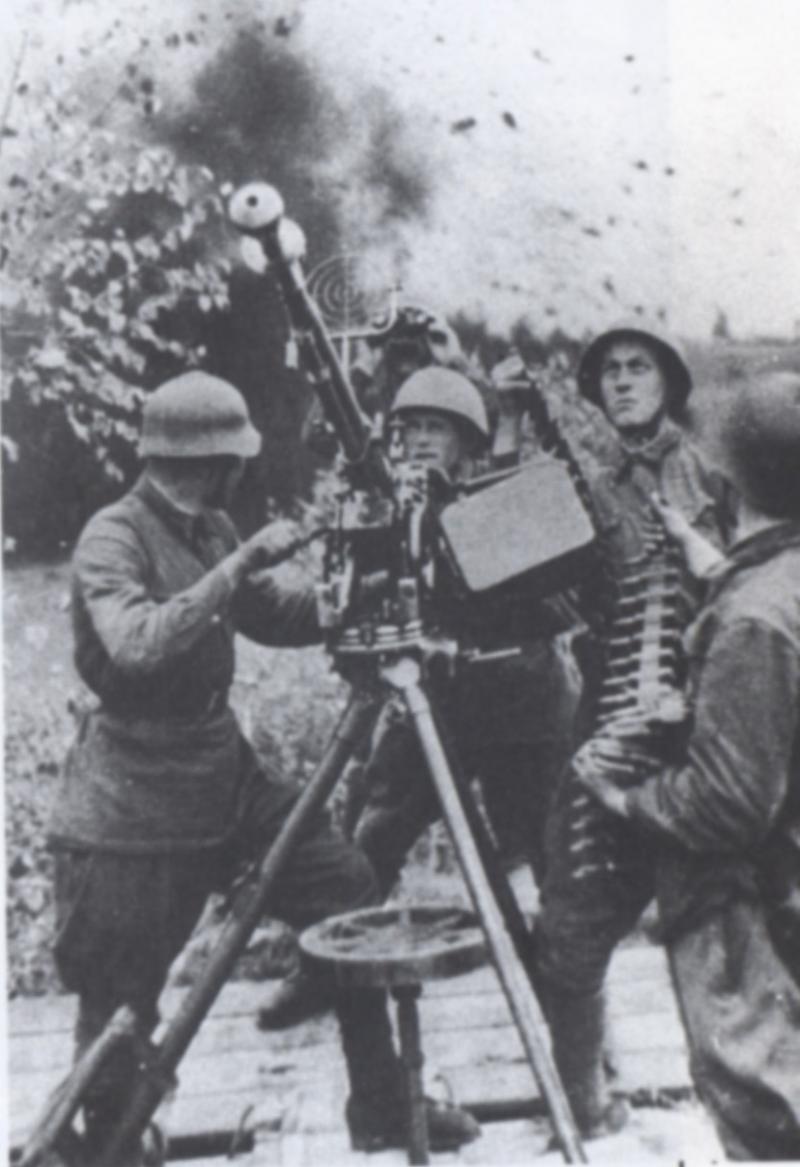
DShK Heavy Machinegun in an Anti-Aircraft Role.
UNIFORMS
General Reference Notes to this Section
1) The 416th portrays a rifle unit in the field. Thus the uniforms you purchase are only required to match the other uniforms of the unit in pattern. They can match in color and fabric if you so desire, but do not have to. The soviet supply system was such that different uniforms were present in each company. This also stemmed from the fact that many locations were making uniforms from different materials.
The unit consisted of old veterans with their uniforms, transfers coming in from other units with their uniforms, new recruits with their uniforms fresh from the depot, on and on. There was one point during the war (Stalingrad) that the 112th Rifle Division (of which the 416th was part of) consisted of survivors from the summer of 1941, replacements from 1942, penal soldiers and factory militia.
Variation was the norm in the Red Army during the war. Color and fabric choices are entirely up to you. Just make sure the tunics you get are M35, M41 or M43 pattern.
2) Events are usually designated Early War or Late War. For uniformity Early War means wear your M35/M41 tunic and Late War means wear your M43 tunic. Event exceptions will be announced, like Mid War or no designated time frame of the war. Most tactical events in the area that we attend are late war and thus would require the M43 tunic. The M43 would be the uniform to get first and then the M35. They are not that expensive, so most members have both.
Tunics “GYMNASTERKA” (Required)
M35 Tunic (Early War)
Colors vary from Green, Brown to Khaki
Collar tabs choices: Black and Raspberry or none at all
Brass Buttons or Green Painted Brass Buttons (Subdued)
Just a note under this category to remove plastic green post war soviet buttons that come on some of the tunics and replace them with proper buttons.
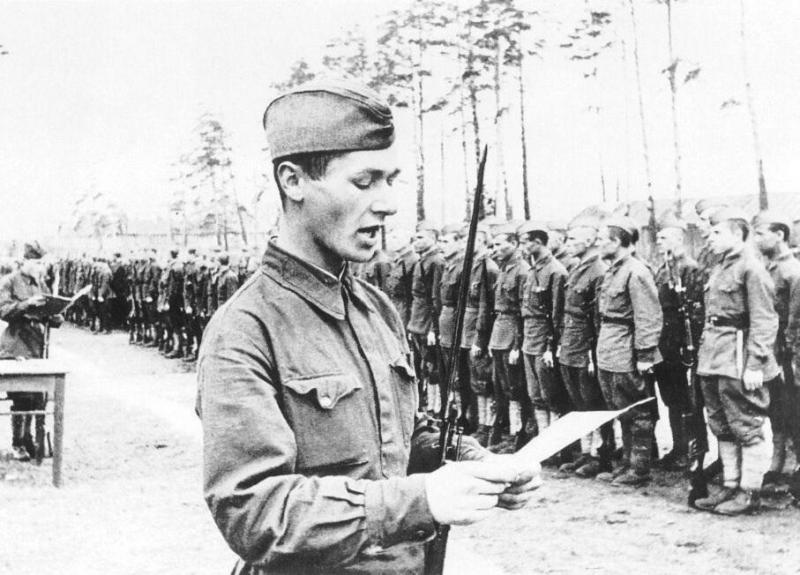
A Red Army soldier wearing an M35 tunic with the M41 regulation subdued collar tabs reads to his company.
M41 Tunic (Early/Mid War)
Based on the 1941 uniform regulations this tunic is the M35 with subdued collar tabs.
M43 Tunic (Mid/Late War)
Colors vary from Green, Brown to Khaki
May also be made from US lend lease cotton or wool material Needs to have raspberry trimmed shoulder boards (raspberry is the infantry service color), either sew on or button on style
Brass Buttons, Green Painted Brass Buttons or Bakelite Buttons
It can either have pockets or no pockets. According to Rio’s book, the M43 was originally issued to enlisted without pockets or elbow reinforcements. It also lacked loops for shoulder boards and those had to be sewn directly to the uniform. As the war progressed the pocketed version was issued more frequently and by 1945 most new uniforms issued were M43’s with pockets.
Just a note under this category to remove plastic green post war soviet buttons that come on some of the tunics and replace them with proper buttons.
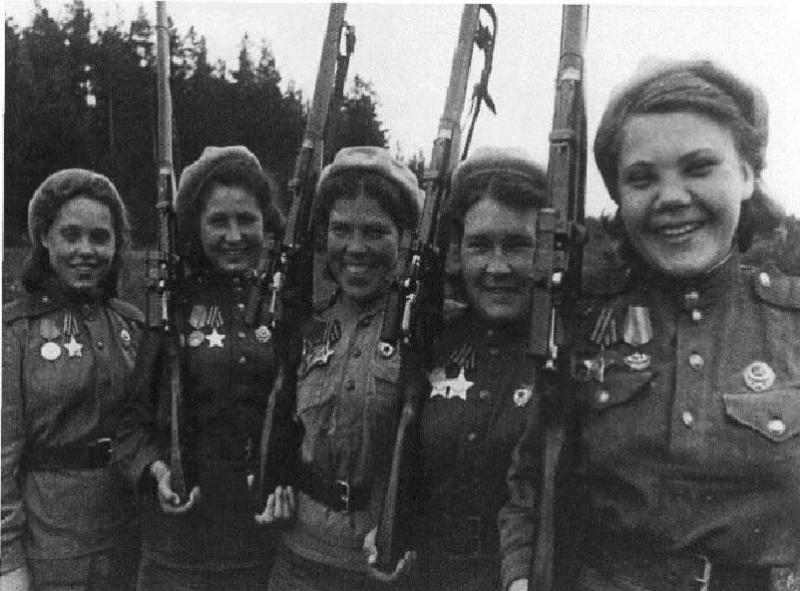
These well decorated snipers wear a combination of M43 tunics with and without pockets. You can also notice the sniper on the right is wearing a collar liner.
Notes on Tunics
Winter issue tunics were made in wool. Cotton summer tunics were also worn in the winter, and with properwinter clothing & underwear there isn’t a problem with staying warm.
In January 1943 the Red Army went from the M35/M41 to the M43. After this regulation a transitional tunic appeared that was a M35 with M43 shoulder boards sewn onto it. This variation of tunic is acceptable for events set in 1943, such as Kursk.
Soviet regulations stated that a white collar liner was to be sewn into all tunics. This is optional as we portray a unit in the field, thus sometimes in combat it didn’t get completed. If you plan on using your tunic as a "dress" tunic you would want to add a liner. They do tend to get dirty real fast.
Trousers “SHAROVARI” (Required)
Trousers came in several different styles, some say it's M35 vs. M43 trousers, others argue there was no designation in trousers, that they are all M35 pattern, that the variations were based on the manufacturer, we’ll go with the simpler of the two.
Differences were mainly in these areas:
Waist Belt vs. Suspenders
Back Tie vs. Buckle
Button foot strap vs. Ankle Ties
Colors varies from Green, Brown to Khaki
Personal choice is allowed on whatever features you desire.
Note on Trousers
Winter issue trousers were made in wool. Cotton summer trousers were also worn in the winter, and with proper winter clothing & underwear there isn’t a problem staying warm enough.
Undershirts (Optional)
Summer - This design was basically a tank top in white, grey or olive drab. Cotton. No ribbed tank tops. Winter - A pullover, banded collar or collarless, long sleeved shirt in white or off-white. Cotton, linen, flannel or wool.
Wearing modern T-shirts under your tunic is forbidden.
Underdrawers (Optional)
Summer - The design was basically boxer shorts in white, grey or olive drab. Cotton. Winter – Button fly, full length white drawers. Cotton, linen, flannel or wool.
Socks/Footwraps (Optional)
Footwraps, which were issued, were rectangular pieces of cloth you wrapped around your foot and then you put your boot on. If done correctly and wrapped tightly they work fine. However more times than not they come undone due to ill-fitting boots and your boots chew your feet up.
An alternate to foot wraps is socks. A nice knitted pair of wool socks from home will work fine. German socks are also acceptable and those are being reproduced. Keep several pairs handy to change socks often. Dry feet are happy feet.
Modern athletic socks are forbidden.
Side Cap “Pilotka” (Optional)
This is your standard folding (envelope) service cap.
Colors vary from green, brown to khaki
They were made in either cotton or wool
Should have a small cap star, either red enamel & brass, or painted olive drab green (subdued) Inner sweat band is optional, some were made without them or the soldiers took the sweat band out.
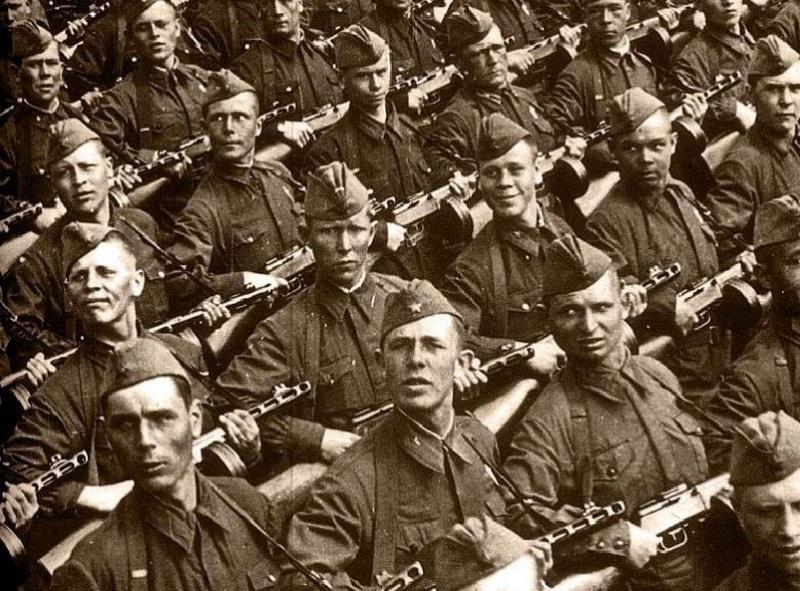
This picture of submachine gunners armed with PPSh-41’s shows them wearing the M35 tunic with the M41 insignia. All of them wear the Pilotka cap.
Note on Pilotkas
It was believed by some of the soldiers that it was manly to wear the pilotka in combat instead of a helmet. However this is not allowed for reenacting due to safety reasons. Helmets are required for events when mortar rounds will be flying and such. Helmets will be covered in the equipment section.
Note on Headgear
Visor hats are reserved for Officers and NCO's only.
Boots (Required)
Low Boots “BOTINKI”
Soviet low boots came from many different sources, quite a few of them came via lend lease. The choice of which type you get is completely up to your personal taste.
Russian made low boots (With Leather Soles/Heels, Leather Soles/Rubber Heels or Rubber Soles/Heels)
Reproduction British Ammo Boots (With Leather Soles/Heels)
Reproduction United States Low Boots (With Rubber Soles/Heels)
Reproduction German Low Boots (With Leather Soles/Heels)
Sole hardware varied in respect to hobnails and toe/heel plates. You may use what you desire or what comes on the boot. Remember however that during the Winter War (1939-1940) the USSR learned why you don't use hobnails in the winter. They act like little cold magnets and increase chances for frostbite. Thus they did away with them.
Puttees
Low boots are to be worn with puttees. These are long pieces of either wool or canvas that are wrapped around the calf. If you decide to go with low boots, you must wear puttees.
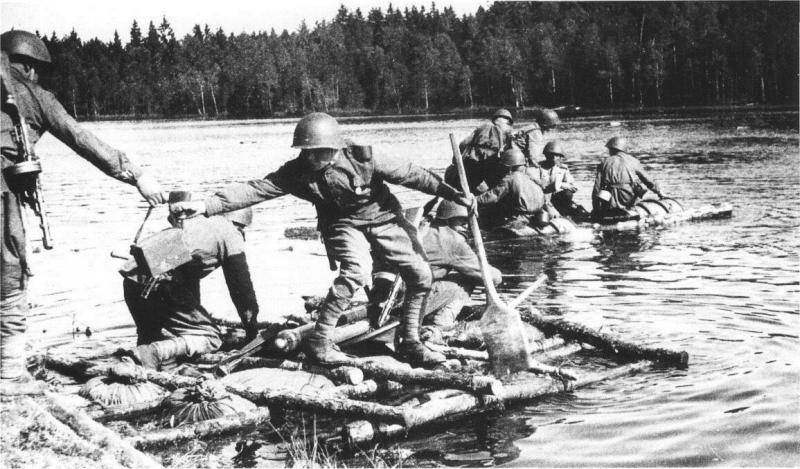
The Red Army crossing a river. The soldier with the paddle is wearing low boots and puttees.
High Boots “SAPOGI”
These are the jackboot style of footwear, laceless pull-on. Soviet boots were made with leather lower parts and impregnated canvas upper parts. Soles varied with leather soles/heels, leather soles/rubber heels or rubber soles/heels. The soles were attached with either nails, pegs or sewn, it varied from maker to maker. All rubber treaded soles are permitted as Toomas at Ostfront pioneered research on this and even found rare pictures of soldiers with rubber soles that had treads.
Sole hardware was a combination of Hobnails and/or Heel/Toe plates, also none at all. The USSR found out during the Winter War (1939-1940) that hobnails acted as little cold magnets and increased a soldier’s chance for getting frostbite. Thus they did away with them by the time of the German invasion. The Germans learned the hard way during their winter of 1941-1942 in Russia.
EQUIPMENT
These items will be tagged as required or optional. Most Soviet soldiers did not carry a full set of field equipment and “lost” some of the items they were issued. This kept the weight down which was important for an army whose primary mode of transportation was their feet.
Some items are required due to reenacting safety reasons. If any item is not listed here, please ask. It may not be a common item for a rifle soldier.
Also important to note we are going to generalize equipment as early or late war and give item BASICS. Some items had so many variations that we couldn’t possibly list them all. For example the M37 leather ammo pouches for the bolt rifles. Some had D-rings for hooking to the M36, M39, M41 packs and some did not. Variations in what was riveted and what was sewn on them abound. Some had the attachment strap sewn to the lid at one point, some at two points, others riveted at one or two points. Too many variations to list them all.
Helmet “SHLEM” (Required)
There were basically two styles of Russian helmets during the war:
M36 - Early War
M40 - Entire War (M39 version is similar, same style shell, different liner)
The M36 was issued in 1936 and appeared in service well into the early part of the war. Even seen as late as Stalingrad. This helmet can also be used for winter war 1939-1940 events.
The M40 was designed to give the Russian soldier a helmet with a more modern look. The M40's had two different styles of liners:
Early Liner (M39) - A cloth liner with a drawstring. Attached to a piece of metal, which was riveted into the helmet. The rivets are high on the shell for this style of liner. Webbing chinstrap.
Mid - Late Liner - This is three oilcloth pads riveted directly into the helmet and were adjusted with a string at the top. The rivets are low on the shell for this style of liner. Webbing chinstrap. Most helmets available on the market have this kind of liner.
Russian helmets were issued in 4 sizes with 1 being the smallest and 4 being the largest.
Incorrect
Czech M40 style helmets!!!!!! With a side note... Czech helmets with a new paint job, a webbing (not leather) chinstrap and a lot of liner work can be converted to look like the M39 helmet.
Notes On Helmets
Helmets are required due to safety rules at most reenactments, especially when mortars are being used by either side.
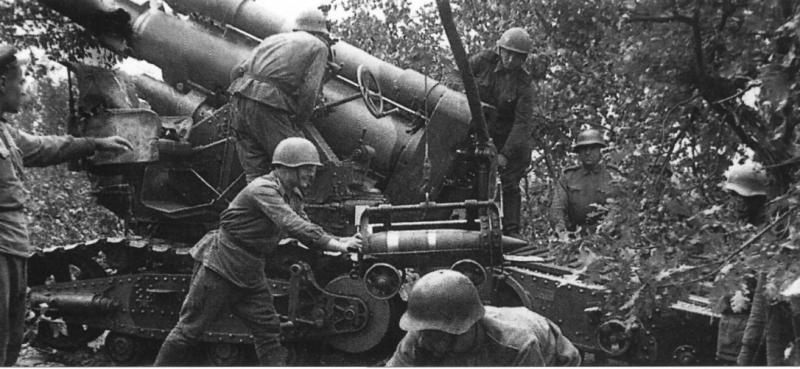
This photo of a gun crew show both the M36 (front leaning over) and M40 (hoisting the shell) helmets. Also of interest is they are wearing the M35/43 transitional tunic.
Belt “REMENIE” (Required)
Either a brown leather belt or a canvas belt with leather reinforcement. That choice is up to you. Should have a roller buckle. Incorrect The post war soviet fake leather belt with the star hammer & sickle plate. The plate was the 1943 regulation dress belt, but this was not seen in the field until well after the war and thus should be avoided.

This photo of Russian prisoners shows them removing their field gear for the Germans. You are able to see they are wearing leather roller buckle belts. The center soldier of the three is wearing a shoulder sling style canteen carrier. Their M35 tunics are devoid of insignia.
Ammunition Pouch “PATRONTACH” (Required)
Bolt Rifle Pouches
Several types of ammo pouches are available and authorized for use, please note early vs. late war. Regulation was to wear two pouches, one left and one right, however plenty of period photographs show a soldier wearing only one.
M93 Czarist Pattern Leather Pouch - Early War
M37 Leather Pouch – Entire War
Note that the rubberized canvas pouches are post war and to be avoided.
SVT-40 Ammo Pouches A leather ammo pouch that can fit the detachable magazine for the SVT-40.
PPSh/PPS Ammo Pouches
Standard canvas pouch made to fit 3 stick magazines or one drum magazine.
The PPSh-41 had a drum magazine when they were first issued and as the war progressed they were fitted with a stick magazine similar to the PPS-43. However to work in the PPSh the stick magazine requires a modification. The PPS-43 used the standard stick magazine. Those weapons could not fit a drum like the PPSh.
Note on Ammo Pouches
Rounds must be carried in ammo pouches for safety reasons. Extra ammo may be carried in packs but must be secured. No loose ammo to be carried in pockets.
Reserve Ammo Pouch (Optional)
These were simple canvas pouches worn on the belt for carrying ammo beyond the rounds contained in the two regular ammo pouches.
Entrenching Tool “LOPATA” (Optional)
Entrenching tools during the war came in basically two styles:
Early War - The handle of the shovel was riveted directly to the blade, using several different pieces. These either came in a pointed tip or a square tip.
Mid to Late War - The blade of the shovel was attached directly to the wooden handle with screws or nails. The metal of the e-tool being one piece. Had a pointed tip.
Entrenching Tool Carrier (Optional)
E-tool carriers also came in two basic designs:
Early War - A brown leather carrier with a strap for securing the E-tool. Either had one or two belt loops.
Mid to Late War - Basically a canvas carrier that closed with a button or a toggle. Colors varied with browns, greens and khaki.
Breadbag (Optional)
This is a small canvas bag worn on the belt. It was present early in the war but quickly disappeared as the war went on.
Grenade Pouch (Optional)
There were two common styles of grenades used by the Red Army during the war and thus there were two types of pouches. The F-1 Egg Grenade and the RGD-33 Stick Grenade. The F-1 pouches carried 3 grenades and the RGD-33 pouches carried 2 grenades.
Made of canvas the colors varied, between greens, browns and khaki. The earlier pouches used a toggle to secure the flap while the later ones used leather and a roller buckle.
Canteen (Required)
Two basic styles of canteen existed in the Red Army. The aluminum canteen with the screw-on top and the glass canteen with a cork. Either is acceptable for your impression at any point of the war.
The metal canteens can either retain their green paint or be stripped to bare metal. Glass canteens are fragile and break easily at events. They were clear or brown glass.
Canteen Carrier (Required)
As with just about everything in the Red Army there several types of canteen carriers:
One was a simple canvas bag the allowed the canteen to be attached to your belt. This used a button to allow you to remove it from your belt. Colors varied, including greens, browns and khaki.
The M38 canteen was attached using a hook and D-ring.
Another was a sling with the bag that was worn over the shoulder. Very simple. Colors varied, including greens, browns and khaki.
Gas Mask Bag (Optional)
There are many variations of gas mask bags, for ease we are going to break it down into two styles:
Early War - These canvas bags were the larger of the two types. The early war bag is typically characterized by the two small pouches on the sides of the bag. They closed with either a buckle or a button. Colors varied with greens and khaki.
Entire War - These canvas bags were smaller than the early war bags and usually lacked the side pouches. They closed with either a toggle or a button. Colors varied with greens and khaki.
Notes on the Gas Mask Bags Russian soldiers sometimes threw away their gas masks and used the gas mask bag as a carry all. Whether you have a gas mask or not is completely up to you.
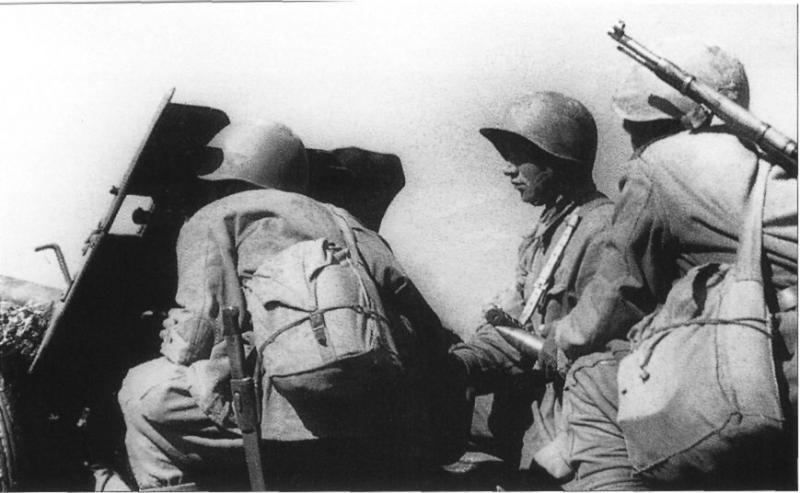
This photo of a gun crew clearly shows the later pattern of gas mask bag. Note the cords wrapped around the bag were to be worn around the waist to keep the bag from flailing around while running. Also of interest is the soldier is clearly wearing a captured German Mauser bayonet and frog.
Knapsack/Rucksack “MIESHOK” (Optional)
Soviet knapsacks/rucksacks came in four models, those were:
M36 Knapsack called "The German Style" Knapsack
M39 Rucksack
M41 Rucksack
M30 Mieshok “Assault Pack”
The M36, M39 and M41 were all early war and quickly disappeared from the battlefields as they were replaced by the Mieshok. M39 & M41 packs are being reproduced; however the M36 is not and is pretty much a collector’s item that commands a fair premium.
A correct WWII Mieshok is being reproduced and post war examples of it can be found. Post war examples must be modified to WWII configuration by removing the back pocket, ID pocket and the side straps.
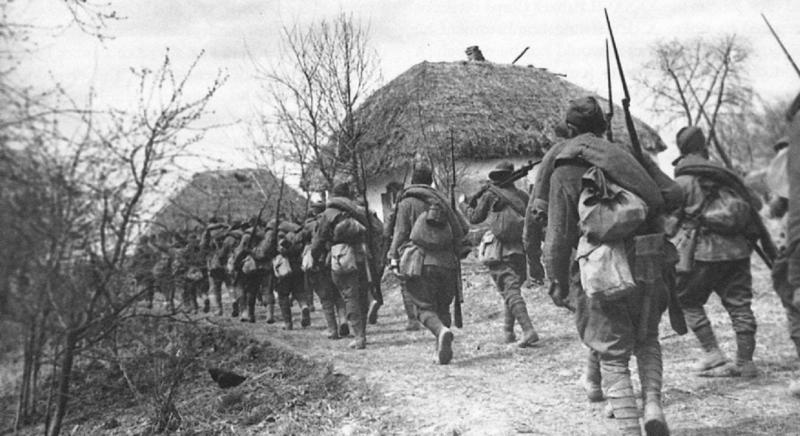
This photo of Red Army infantry entering a village shows the M30 Meshok pack. Several other items to note are the gas mask bags, e-tools and the German style mess kit.
Bandoleer (Optional)
Once again there were two basic styles used by the Red Army.
Style 1 - was a six-pocket bandoleer for carrying six stripper clips of ammo. 30 rounds. They were made in either green or tan canvas.
Style 2 - was a five-pocket bandoleer that held four stripper clips of ammo and one F-1 grenade. 20 rounds and the grenade. They were made in either green or tan canvas.
Bayonet Scabbard (Optional)
This item was made from green canvas or leather. It was extremely rare and disappeared very early in the war. As most soldiers carried their bayonets on the muzzle, either fixed or reversed.
If you carry a bayonet onto the battlefield for safety reasons you can tie the bayonet reversed to the muzzle of the gun securely if you do not have a canvas bayonet scabbard. This of course will only work with the M91/30. The M91 bayonet has a locking ring and will not securely fit reversed. The M38 doesn't have a bayonet. The M44 has a folding bayonet that secures in its folded position. The SVT bayonet had its own belt scabbard.
The only alternative to the scabbard or tie in reverse is to leave the bayonet in camp or your vehicle.
Mess Tin/Mess Pot “KOTELOK” (Optional)
The mess tin is metal, two pieces and painted green. It resembles the German mess tin. The top works nicely as a small dish and the bottom works as a cook pot. This is not being reproduced, however post war originals are common, very inexpensive and will work if repainted. The Russians were also issued a mess pot. This is a one piece metal pot, like a bucket. These vary in size and some are painted green or left unpainted.
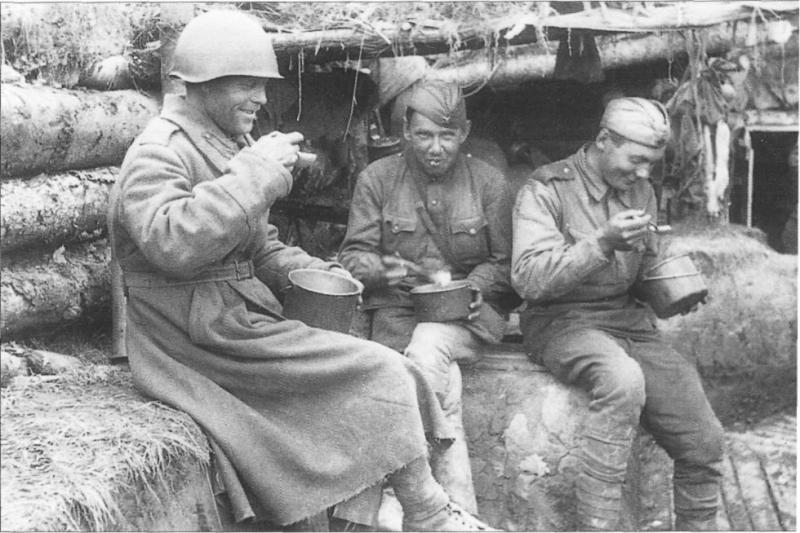
Red Army soldiers enjoying a meal in their dugout. All three are using the mess pot, while the center pot appears to not be as tall as the others. The center soldier is wearing a M43 tunic; however it is missing its shoulder boards. The soldier on the left is wearing the later pattern greatcoat with full insignia (collar tabs and shoulder boards). Note the greatcoat is unhemmed. Also he is wearing a canvas and leather belt.
Shelter Half - Rain Cape “PLASHCH-PALATKA” (Optional)
This piece of equipment is optional but highly recommended. Basically it is a kind of rectangular piece of green tightly woven canvas with a slit in it. It was to be buttoned together with another to form a tent, similar to the United States dog tent. It also doubled as a rain cape as it had neckties and the slit was to be used for your arm. These should have wooden toggles for buttoning them together with other palatkas. They should also have leather (not metal) reinforced grommet holes for staking it to the ground.
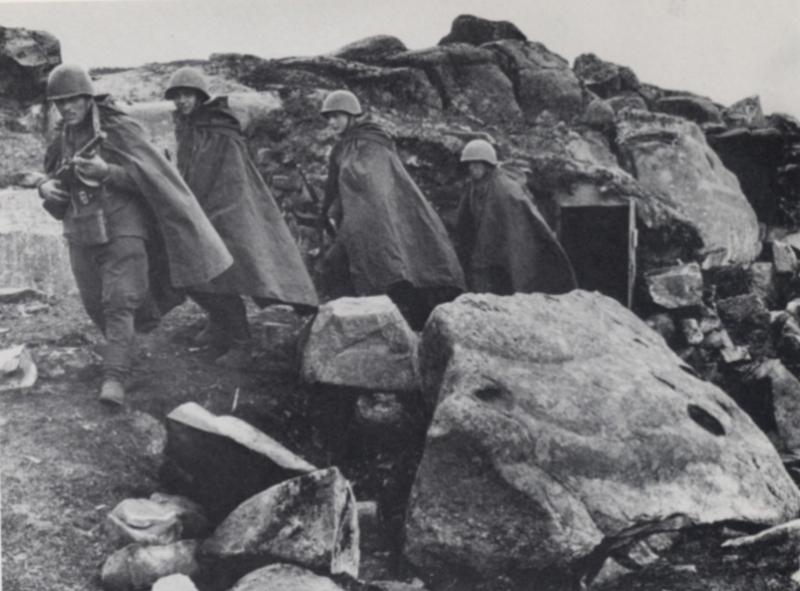
This photo shows a Red Army patrol all clad in their Plashch-Palatkas.
WINTER UNIFORMS AND EQUIPMENT
Greatcoat “SHINEL”
This is heavy, grey/brown wool, full-length greatcoat with a cotton lining. The front was closed by hooks, no buttons on the front.
Insignia on the coats varied along the same lines of those for the M35, M41 & M43 tunics:
Early Insignia - A diamond shaped patch of raspberry cloth with black piping or a subdued diamond shaped patch of green sewn to each of the collars.
Late Insignia – Was a raspberry with black piping tab or a green (subdued) with raspberry piping tab with a button sewn to each tab. Shoulder boards can also be worn on the coat but very rarely was this done.
No Insignia – More common was that no insignia was worn on the coat.
Padded Jacket “TELOGREIKA”
This is the famous soviet padded jacket seen in the wartime photos. It was khaki, brown or green cotton with quilted padding. With either black bakelite buttons or painted brass buttons. It basically came in two styles:
Early War - This padded jacket had fall collars. Insignia were raspberry and black collar tabs, subdued green collar tabs, or no collar tabs at all.
Mid to Late War - This padded jacket has standing collars and provisions for shoulder boards. Often the shoulder boards were left off this jacket.
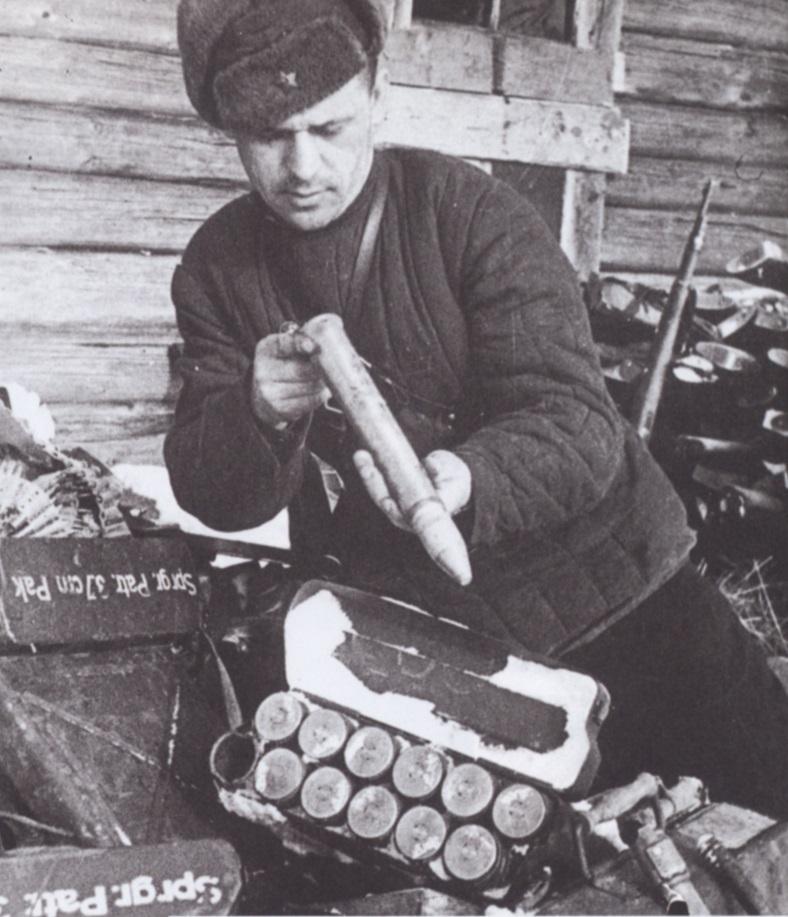
In this photo a Red Army soldier inspects captured German 37mm ammo. The soldier is wearing the Telogreika without any insignia. He also has the Fish Fur Ushanka winter hat. Interesting is directly behind him is a stack of captured rifles. Cloth ammo belts to the left.
Padded Trousers “VATNI SHAROVARI”
Basically a pair of winter trousers using the same padding system that was used in the Telogreika. These were khaki, brown or green cotton with quilted padding. With black bakelite or metal dish buttons.
Budionovka
This was a brown or brown/grey wool cap that was pre-war and early war issue. With a raspberry colored cloth star on the front and a large brass red star in the center of that cloth star. The side flaps folded down around your face to protect you from the elements. These flaps were held up with either a brass button or a painted button. There was a summer variant of this hat made in cotton. However, those were basically pre-war and might have been worn early in the war, but disappeared quickly.
Incorrect
There are vendors selling them with red trim that is incorrect.
Shapka-Ushanka
This is the standard soviet winter issue hat. It was made of wool and "fish fur" a synthetic fur material. The flaps tied at the top and folded down around the ears and neck to protect you from the elements. On the front was a large brass red star. Colors varied from grey to brown-grey to dark tan.
Incorrect
Post war soviet ushankas in Grey, White or Black are incorrect. The materials are not the same as WWII and thus give it an improper look.
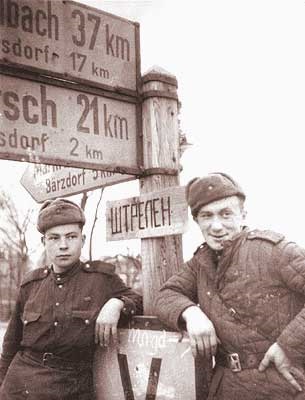
These soldiers strike a casual pose at a German signpost. Both are wearing the Ushanka winter hat. The officer on the right, noted by his officer’s star belt, is wearing a Telogreika with shoulder boards.
Helmet
The helmet was the M36 or M40 style helmet. They were whitewashed using a combination of chalk and water. Paint is also acceptable and less likely to rub off all over your clothing and car. However the reason we included it here was to mention a common red army winter practice.
That was they would remove the liner from the helmet and wear it directly over their Ushankas. If you do this make sure to leave the chinstrap attached so that the helmet will stay on.
Gloves/Mittens
This was a lambskin, leather or knitted wool pair of gloves. Some lined and some not. Most were a three-fingered mitten style. The index finger being free from the other fingers so that you could fire your weapon.
Pressed Felt Boots “VALENKI”
These were a prized item, they basically resembled a pair of jackboots, however they were made entirely from pressed wool/felt. They were grey, brown, or grey/brown. With no rubber attached to the soles.
Notes on Valenki
Valenki are made to be worn in well below freezing conditions. If you wear them when there is any snowmelt present you will notice that they absorb water. This will negate their insulating properties and give you cold wet feet. Rubber pull overs for Valenki are recommended for wetter weather; however, there isn't any available source for these.
Winter Camouflage
There was basically two types of winter camouflage. One piece, full length to be worn over the greatcoat and a two piece top w/hood and bottom to be worn over the padded uniform. Made from white cotton.
Not all units were issued winter camo, and more times than not they fought in the winter without any issue of winter camo at all.
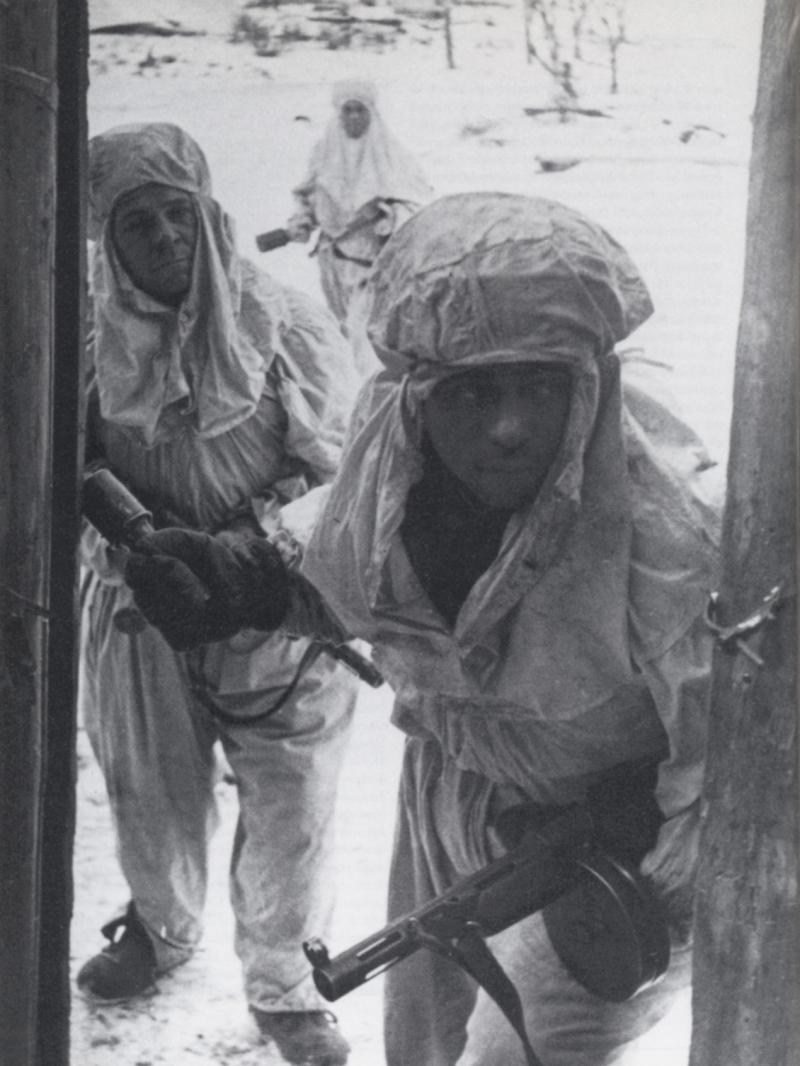
Red Army soldiers in two piece white snow camo suits. Notice the RGD33 hand grenade is lacking a fragmentation sleeve and the soldier carries a PPD submachinegun, the precursor to the PPSh.
White Canvas Field Gear
This goes hand in hand with the winter camo suits. Not all units were issued these and even those that got the camo suits may not have gotten these. These were white canvas ammo pouches and white canvas grenade pouches.
MISCELLANEOUS ITEMS
This page is entirely made up of OPTIONAL items that you may desire to get to improve your impression and take it to the next level. Sweating the small stuff is worth it in the world of reenacting.
We'll not go into details on each item. Just a basic list.
Aluminum Mug/Cup
Flashlight/Torch
Gas Mask & Filter
ID Book
Mosin Nagant Cleaning Kit
Personal Items Bag
Equipment Straps
Large Metal or Wooden Spoon
Knitted Winter Cap/Hood
Pocket Watch or Wrist Watch
Tobacco Pouch
Note on watches: It would have been uncommon for a regular red army soldier to have a watch. However if you do decide to carry one make sure it is period correct. Also note a watch was a popular item to loot from dead or captured German soldiers. So if you wear/carry one, a German watch would be even better.
Special Note...
Eyeglasses
For those who have to wear glasses, period frames are a must. No one is making Soviet reproduction frames, however many antique stores have period frames. Usually inexpensive. All you need to do is take them to an eyeglass place to have your prescription put in them. Another option is to buy German Reproduction glasses.
This one aspect of your impression can make or break it. Nothing looks worse than someone that takes the time and effort to have a proper uniform and kit, only to ruin it with modern glasses. Contacts are acceptable.
BIBLIOGRAPHY
Many books were consulted in the writing of these uniform guidelines. We will list some of the ones that were useful here.
They can be broken down into three types;
Books that deal directly with soviet WWII uniforms and equipment. These provide in depth photos and descriptions of each item or uniform.
Books with pictures of soviet soldiers in WWII. These show soviet soldiers in the field giving us a look at the uniforms and equipment that they wore.
Memoirs of those that fought on the eastern front. Those books can contain a wealth of information on how things were done. Best of all they were written by the veterans we seek to honor.
Also used in the writing of these guidelines were many original items that members of the 416th and other reenacting groups have in their collections. With the fall of the Soviet Union these items have become available in western markets in growing quantities. Nothing like having the originals to examine.
Finally a big THANK YOU goes out to Toomas of the now defunct ostfront.com vendor site. His website had been a good place to see lots of pictures of original equipment. Also his informative postings on the red guards message board were valuable. He went the extra mile to answer questions about gear and uniforms with in depth research of original artifacts and often posted photos. Truly very helpful. Thank you Toomas.
This list will be updated as more books are acquired and reviewed. It is by no means definitive. One change we made was to drop the listing of books that deal with specific battles. There are so many covering specific battles that are loaded with good pictures of the soldiers. We’ll leave you to find those on your own.
Litvin, Nikolai : 800 Days on the Eastern Front (2007)
Erickson, John & Ljubica : Eastern Front in Photographs 1941-1945, The (2001)
Fowler, Will : Eastern Front, The Unpublished Photographs 1941-1945 (2001)
Miller, David : Fighting Men of World War II Allied Forces (2008)
Fisch, Robert : Field Equipment of the Infantry 1914-1945 (1989)
Kobylyanskiy, Isaak : From Stalingrad to Pillau (2008)
Mikhin, Petr : Guns Against the Reich (2010)
Suermont, Jon : Infantry Weapons of World War II (2004)
McNab, Chris : Military Uniforms Visual Encyclopedia (2011)
Lapin, Terence W. : Mosin-Nagant Rifle, The (1998)
Gebhardt, James F. : Official Soviet Mosin-Nagant Rifle Manual, The (2000)
Porter, David : Order of Battle, The Red Army in WWII (2009)
Drabkin, Artem : Red Army at War, The (2010)
Zaloga, Steven J.; Ness, Leland S.: Red Army Handbook 1939-1945 (1998)
Zaloga, Steven J.; Volstad, Ron: Red Army of the Great Patriotic War 1941-5, The (1984)
Shalito, Anton; Savchenkov, Ilya; Roginsky, Nikolay; Tsyplenkov, Kirill : Red Army Uniforms 1918-1945 in Color Photographs (1991)
Shalito, Anton; Savchenkov, Ilya; Mollo, Andrew : Red Army Uniforms of World War II in Color Photographs (1993)
Abdulin, Mansur : Red Road from Stalingrad (2004)
Mrazkova, Danela; Remes, Vladimir : Russian War: 1941-1945, The (1975)
Zaloga, Steven J. : Soviet Army Uniforms in World War Two (1985)
Rio, Philippe: Soviet Soldier in World War Two, The (2012)
Bekesi, Laszlo; Torok, Gyorgy : Soviet Uniforms & Militaria 1917-1991 in Color Photographs (2000)
Bessonov, Evgeni : Tank Rider into the Reich with the Red Army (2003)
Gorbachevsky, Boris : Through the Maelstrom (2008)
Webster, David; Nelson, Chris : Uniforms of the Soviet Union 1918-1945 (1998)
Salisbury, Harrison E. : Unknown War, The (1978)
Lucas, James : War on the Eastern Front (1979)
Khaldei, Yevgeny : Witness to History, The Photographs of Yevgeny Khaldei (1997)
Haskew, Michael : World War II Collectibles (2010)
Mirouze, Laurent : World War II Infantry in Color Photographs (1995)
Grossman, Vasily : Writer at War, A (2005)
Special Mention Books
Hastings, Max : Victory in Europe (1985)
The reason that this is a special mention is that while the book mainly deals with the western front and a little about the east, it has something that makes it a valuable resource to us. It has COLOR photographs of red army soldiers in late war uniforms taken by a US photographer at the east/west meetings and immediately after the war in Berlin. Yes I said COLOR COLOR COLOR!!!!! Not colorized, actual COLOR photos. Very nice to look at.
Cornish, Nik : Stalingrad – Victory on the Volga (2009)
The special mention for this book is because it has photos specifically of the 112th Rifle Division.